
Best Dental Insurance Verification Software (2026)
Unverified patients mean surprise denials, awkward chairside conversations and staff on hold with payers for 20 minutes a call.

Unverified patients mean surprise denials, awkward chairside conversations and staff on hold with payers for 20 minutes a call. Aron's insurance verification helps your team review benefits before the visit and write the breakdown back into your PMS.
Dental insurance verification software checks a patient’s eligibility, benefits and coverage details before the visit, so your team knows what the plan covers before treatment starts. The main differences are eligibility-only vs a full benefits breakdown, whether it writes back to your PMS, and price.
Which to pick if…
- You want verification plus phones, payments and more in one platform — Aron.
- You want RCM and insurance verification data — Zuub.
- You already use Vyne for claims and attachments — Vyne Trellis.
TL;DR / Key Takeaways
- Manual insurance verification drains front office resources and can lead to errors, denials and frustrated patients.
- The best software offers more than eligibility: deductibles, annual maximums, procedure history, waiting periods and frequencies.
- Direct PMS write-back reduces transcription and manual data entry.
- Look for batch verification, plan matching and electronic payer connections.
- Aron combines automated verification with phones and payments at a flat monthly rate.
| Tool | Best for | Eligibility vs full breakdown | Writes back to PMS | Price |
|---|---|---|---|---|
| Aron | Practices that want verification, phones and payments in one system | Full breakdown | Yes | Pro plan $799/mo incl. 150 verifications/mo |
| Zuub | RCM and insurance verification data | Full breakdown | Yes | Contact for pricing |
| Vyne Trellis | Existing Vyne claims and attachments users | Eligibility | No | Contact for pricing |
| DentalXChange | Bundled clearinghouse and verification | Eligibility | No | Contact for pricing |
| Pearly | Modern practices with membership plans | Benefit summaries | Not published | Contact for pricing |
| Trojan Professional Services | Human-assisted benefits research | Benefit reporting | Not published | Contact for pricing |
| Onederful | Focused verification and detailed data | Full breakdown | Not published | Contact for pricing |
| Dental Intelligence | Existing DI analytics users | Not published | Not published | Contact for pricing |
Wasting hours on hold with insurance companies, only to get partial information, is a familiar nightmare for every dental front office. This bottleneck burns staff time and affects treatment estimates and claims. Dedicated software can automate the process from initial check to PMS entry.
Why Automated Insurance Verification Matters in 2026
Manual verification is one of the biggest administrative time sinks. Phone calls and web portals create these pain points:
- Wasted Staff Hours: Manual verification means phone calls or portal logins for each patient. The 2021 CAQH Index, as reported in the Journal of the Colorado Dental Association, found each manual verification takes at least 12 minutes for the check alone, and about twice that once follow-up on claim issues is counted. Time your team's checks for one week before you compare tools, so you know what you are trying to save.
- Inaccurate Treatment Plans: Without deductibles met, remaining maximums, frequency limits and waiting periods, estimates are built on guesswork.
- Increased Claim Denials: Invalid or expired coverage can lead to denials. Verifying before the visit leaves time to resolve issues and supports Revenue Cycle Management.
- Reduced Case Acceptance: Clear out-of-pocket estimates help patients make treatment decisions; vague estimates create hesitation.
- Poor Patient Experience: Waiting for a payer call or getting an unexpected bill can harm trust and retention.
What to Look for in Dental Insurance Verification Software
Prioritize tools that deliver on these criteria.
Accuracy and Detail of Benefit Breakdowns
Basic eligibility confirms whether a patient is covered. Look for annual maximums, deductibles and amounts met, frequencies and limitations, procedure history, waiting periods, downgrades and missing-tooth clauses. Payer data varies, so confirm which fields are actually returned. See how to automate dental insurance verification.
Seamless PMS Write-Back Automation
The software should write verified benefit data directly into Open Dental, Dentrix, Eaglesoft or your other PMS. Without this, staff still transcribe data between screens. Ask for a demonstration of the specific fields and patient record that will change.
Intelligent Automation and Workflows
Look for scheduled batch checks ahead of visits and real-time verification when new patients are booked. Batch verification helps your morning huddle use current information, whether a team member or an AI receptionist created the appointment.
Broad Payer Coverage and "Fuzzy" Matching
Confirm electronic connections to the payers your practice uses. Plan matching should help resolve patient-entered names such as MetLife PPO to the correct plan, while uncertain matches remain visible for review.
What a verified patient should look like in the chart
When verification works, your team opens the patient's insurance record and sees these fields filled in, not a note that says "verified":
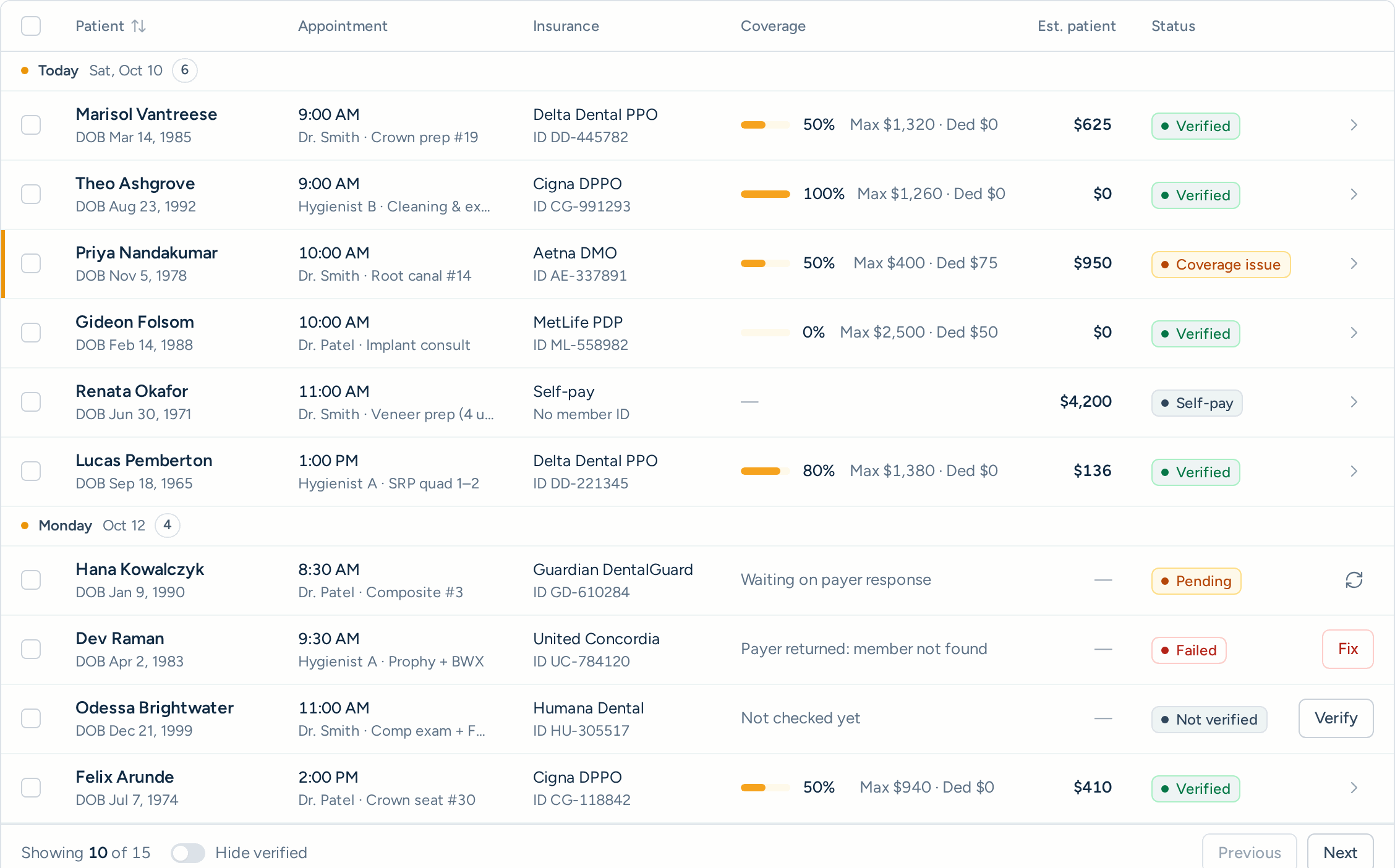 Sample data
- Plan status, subscriber and effective dates
- Annual maximum and the amount remaining
- Deductible and the amount met
- Coverage percentages for preventive, basic and major services
- Frequency limits, such as how often cleanings and exams are covered
- Waiting periods, downgrades and missing-tooth clauses
- Whether secondary coverage exists and needs review
Payers return different fields, so confirm which ones each vendor actually returns for the plans in your patient mix. A tool that returns eligibility only still leaves your team making calls for the rest.
The Best Dental Insurance Verification Software in 2026
Each of these tools has different strengths and target practices.
1. Aron
Best for: Aron is best for dental practices that want insurance verified automatically before every visit, with the benefit breakdown written back into the PMS (Dentrix, Eaglesoft, Open Dental, Curve, Denticon).
Aron's insurance verification runs scheduled batch and real-time checks, returns benefit breakdowns and writes supported fields back into your PMS. Electronic payer responses vary; exceptions stay visible for staff review.
Features: Automated electronic eligibility checks with US dental payers, detailed benefits, batch checks, direct PMS write-back and plan matching, alongside phones, payments, recall, patient forms and marketing. Aron supports 17+ practice management systems and sends automated sync health alerts if a connection drops.
Pricing: Pro $799/mo, including 150 verifications/mo. HIPAA-aligned with a signed BAA; no long-term contracts.
Bottom line: A unified option for practices that want verification, phones and payments in one system.
How it runs day to day: scheduled checks run in a batch at 6:00 AM, so results are ready when your team starts the day, and Pro also includes real-time verification with 150 checks a month. Plans that can't be matched or verified stay visible as exceptions for staff to review.
2. Zuub
Best for: Practices focused purely on RCM and insurance verification data.
Zuub specializes in insurance verification and revenue cycle intelligence. It provides detailed benefit breakdowns and a modern interface, helping practices understand payer mix and fee schedules. It operates as a standalone RCM solution rather than a complete patient communication and marketing platform.
Features: Detailed eligibility and benefits data, automated workflows, fee schedule analysis and PMS integration. The existing comparison describes automated PMS write-back.
Pricing: Contact for pricing.
Bottom line: A specialized option for deep insurance intelligence managed separately from communication and marketing.
3. Vyne Trellis
Best for: Practices already using Vyne for claims processing and attachments.
Vyne is established in claims and attachment services, formerly NEA. Trellis incorporates real-time eligibility into that ecosystem. Existing Vyne users may prefer consolidation, though benefit detail may not be as exhaustive as specialized tools.
Features: Real-time eligibility, claims and attachments integration, a large payer network and an established industry presence.
Pricing: Contact for pricing.
Bottom line: A logical choice for existing Vyne customers consolidating RCM tasks.
4. DentalXChange
Best for: Practices looking for a bundled clearinghouse and verification package from an established provider.
DentalXChange offers eligibility as part of ClaimConnect. Its traditional workflow handles claims and verification for practices that prioritize stability and a claims bundle over a broader engagement platform.
Features: Integrated claims processing, real-time eligibility, online patient payments and a large payer list.
Pricing: Contact for pricing.
Bottom line: A claims-and-verification option for practices that do not need a broader engagement suite; see Demandforce alternatives.
5. Pearly
Best for: Modern, tech-savvy practices, particularly those with in-house membership plans.
Pearly began with membership plans and expanded into RCM and patient engagement. Its verification tool emphasizes real-time checks and clear benefit summaries.
Features: A modern interface, real-time verification, membership management and patient payments. The existing copy does not confirm automatic PMS write-back.
Pricing: Contact for pricing.
Bottom line: A fit for practices combining in-house membership plans and traditional insurance management.
6. Trojan Professional Services
Best for: Practices that prefer a high-touch, service-based approach over pure software.
Trojan offers benefits research through a plan database and human investigation of harder-to-verify plans. This approach can involve more manual work than a fully automated workflow.
Features: Benefit data, access to a large plan database and human-assisted research for difficult cases.
Pricing: Contact for pricing.
Bottom line: An option for practices prioritizing human-assisted benefits research over hands-off automation.
7. Onederful
Best for: Small to mid-sized practices looking for a focused verification tool.
Onederful focuses on detailed, standardized benefit breakdowns. Its existing description includes AI-assisted extraction, automated workflows and major PMS integrations.
Features: Detailed benefits, standardized output, PMS integration and automated batch verification. Automatic write-back is not explicitly confirmed in the existing copy.
Pricing: Contact for pricing.
Bottom line: A focused option for verification data rather than a complete marketing and communication suite.
8. Dental Intelligence
Best for: Large practices or DSOs already deeply invested in the DI analytics platform.
Dental Intelligence includes verification in its broader analytics and engagement platform. Existing users may value workflow consistency, while practices seeking a standalone option should compare the work left for staff. See alternatives to Dental Intelligence.
Features: Analytics suite integration, patient communication tools and verification status in dashboards. The existing copy does not specify breakdown detail or automatic write-back.
Pricing: Contact for pricing.
Bottom line: A convenient addition for existing DI users; compare the full platform cost against a focused verification tool.
Comparison of Top Dental Insurance Verification Software
| Feature | Aron | Zuub | Vyne Trellis | DentalXChange | Pearly |
|---|---|---|---|---|---|
| Detailed Benefit Breakdowns | Yes | Yes | Confirm detail | Confirm detail | Benefit summaries |
| Automated PMS Write-Back | Yes | Yes | No in existing comparison | No in existing comparison | Not published |
| Batch Verification | Yes | Yes | Confirm | Confirm | Yes in existing comparison |
| Plan Matching | Yes | Yes | Confirm | Not stated | Yes in existing comparison |
| All-in-One Platform | Yes | RCM focused | Claims focused | Claims focused | Membership and RCM |
Questions to ask every vendor before you buy
| Question | Why it matters |
|---|---|
| Which of my payers return a full benefit breakdown, and which return eligibility only? | Eligibility-only results still leave calls for your team |
| Which fields write back to my PMS, and can you show it on my PMS version? | Write-back is what removes the retyping |
| How are plans that can't be matched shown to staff? | Hidden failures become surprise denials |
| Is secondary insurance checked? | Coordination of benefits changes the estimate |
| Is it priced per check, per provider, per location or per month? | The pricing unit decides what a busy month costs |
| What happens above the included volume? | Overage rules are easy to miss |
| What is the term, and what is the renewal price? | Auto-renewal and price changes are the usual surprises |
| Will you sign a BAA? | You need one before any patient data is shared |
Pricing Overview: What to Expect
Most vendors quote custom pricing. Compare per-verification fees, tiered monthly subscriptions and bundled platform pricing. Ask about provider and location charges, setup, transaction limits and renewal terms. Aron includes 150 verifications/mo on Pro at $799/mo, with no long-term contract. Verification volume beyond the included allowance should be discussed before enrollment.
How Practices are Switching to Automated Verification
- Choose Your Partner: Prioritize supported write-back fields, useful breakdowns and pricing that fits your practice.
- Test on your own data: Ask how the tool works with your actual PMS and payer mix.
- Secure Integration: Connect the PMS securely; Aron supports your PMS with automated sync health alerts.
- Configure Automation: Set which appointments are verified and when, rather than assuming every workflow is enabled.
- Train Your Team: Review the populated data and exceptions instead of manually checking everyone.
Verification company or software?
Searches for a "dental office insurance verification company" usually mean outsourcing: a service whose staff call payers or use portals and send you the results. That can help with hard-to-verify plans or with a front desk that is short-staffed. Software automates the electronic checks and writes the results into your PMS. The right choice depends on your patient volume, your payer mix and how much of the work you want off your team's plate. Some practices use software for most patients and a service for the exceptions. For the cost comparison, see our insurance verification outsourcing vs software guide.
Frequently Asked Questions (FAQs)
What is dental insurance verification software?
It checks a patient's coverage with the payer electronically and returns the results to your team, ideally written into the patient's insurance record in your practice management system (PMS). Better tools return a full benefit breakdown, not just whether the policy is active.
What's the difference between eligibility and a full benefit breakdown?
Eligibility simply confirms if a patient's policy is active on a given day. A full benefit breakdown details the deductible and amount met, annual maximum and remaining amount, coverage percentages, waiting periods and frequency limits. Available detail depends on the payer.
How does automated insurance verification software write back to my PMS?
The software connects securely to your PMS and maps returned benefit data to supported fields in the patient's insurance record. Ask the vendor to demonstrate which fields are updated and how staff review exceptions.
When does Aron run insurance verification?
Aron runs scheduled checks in a batch at 6:00 AM, so results are ready when your team starts the day. Pro also includes real-time verification, with 150 checks a month included.
Can this software handle secondary insurance?
Modern platforms can check primary and secondary policies. Verification is person- and policy-specific; coordination of benefits may still need review. Confirm support with your vendor before relying on the estimate.
Is real-time insurance verification truly "real-time"?
It sends an electronic query when the check is requested, rather than waiting for a scheduled batch. A response often arrives within seconds to a minute, but timing and availability depend on the payer's system.
How much time can my practice save with this software?
Savings depend on patient volume, payer responses and how much data writes back automatically. Time your team's manual checks for one week, then compare after the software is running, including the exceptions that still need review.
What happens if the software can't find a patient's plan?
No system verifies every plan electronically. Incorrect details, unavailable payer systems or unsupported plans should be flagged for manual review. Aron keeps these exceptions visible so staff know which patients need follow-up.
How much does dental insurance verification software cost?
Most vendors quote custom pricing. Aron includes 150 verifications a month on its $799 Pro plan, with no long-term contract. Ask any vendor about volume beyond the included allowance before you enroll.
Which insurance verification software writes back to Dentrix, Eaglesoft or Open Dental?
Aron writes supported benefit breakdown fields back into Dentrix, Eaglesoft and Open Dental, as well as Curve and Denticon. Zuub is also described in this guide as supporting PMS write-back. Ask each vendor to demonstrate the exact fields in your PMS.
Is outsourcing insurance verification cheaper than software?
It depends on patient volume, outsourcing fees and staff time. Compare the full cost and the work that remains for your team in our insurance verification outsourcing vs software guide.
Should I use a verification company or software?
A verification company uses people to call payers or use portals and sends you the results, which can help with hard-to-verify plans. Software automates the electronic checks and writes results to your PMS. Some practices use software for the bulk of patients and a service for exceptions.
Stop Wasting Time on Hold. Start Growing Your Practice.
Stop calling payers. Book a 30-minute demo and watch Aron verify a real patient.
Related reading
Considering a verification company instead? Read insurance verification outsourcing vs software.
Keep reading
- In-Network vs Out-of-Network Dental Insurance: Should You Drop PPO Plans?
- How to File a Dental Insurance Claim (Step by Step)
- Dental Insurance Verification Form: Free Template and Checklist
- Dental Insurance Frequency Limitations by Procedure
- EDI vs API: Understanding Modern Dental Insurance Verification Technology
Head-to-head comparisons