
Lapsed Patient Detection
Automatically identify patients who haven't been seen in 6, 12, or 18+ months. No manual chart audits required.
Product›Communication
Communication · Patient reactivation
The average dental practice has hundreds of inactive patients sitting in their PMS. Aron finds them, ranks them by revenue potential, and helps you bring them back, automatically.
What it does
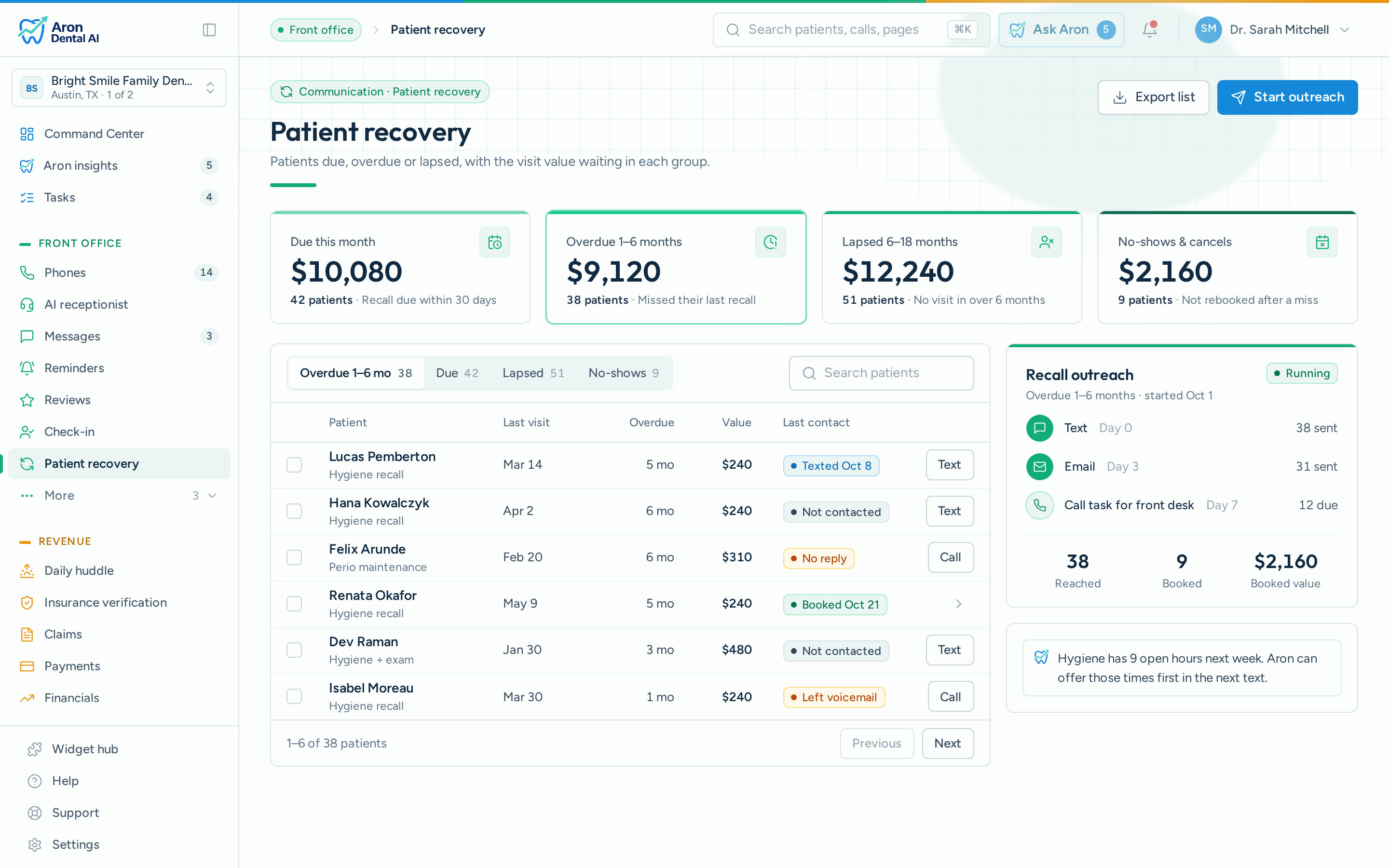
Connect your practice management system. Aron automatically identifies every lapsed patient and their treatment history.
Review patients sorted by outstanding balance and pending treatment plans. Focus on the reactivations that matter most.
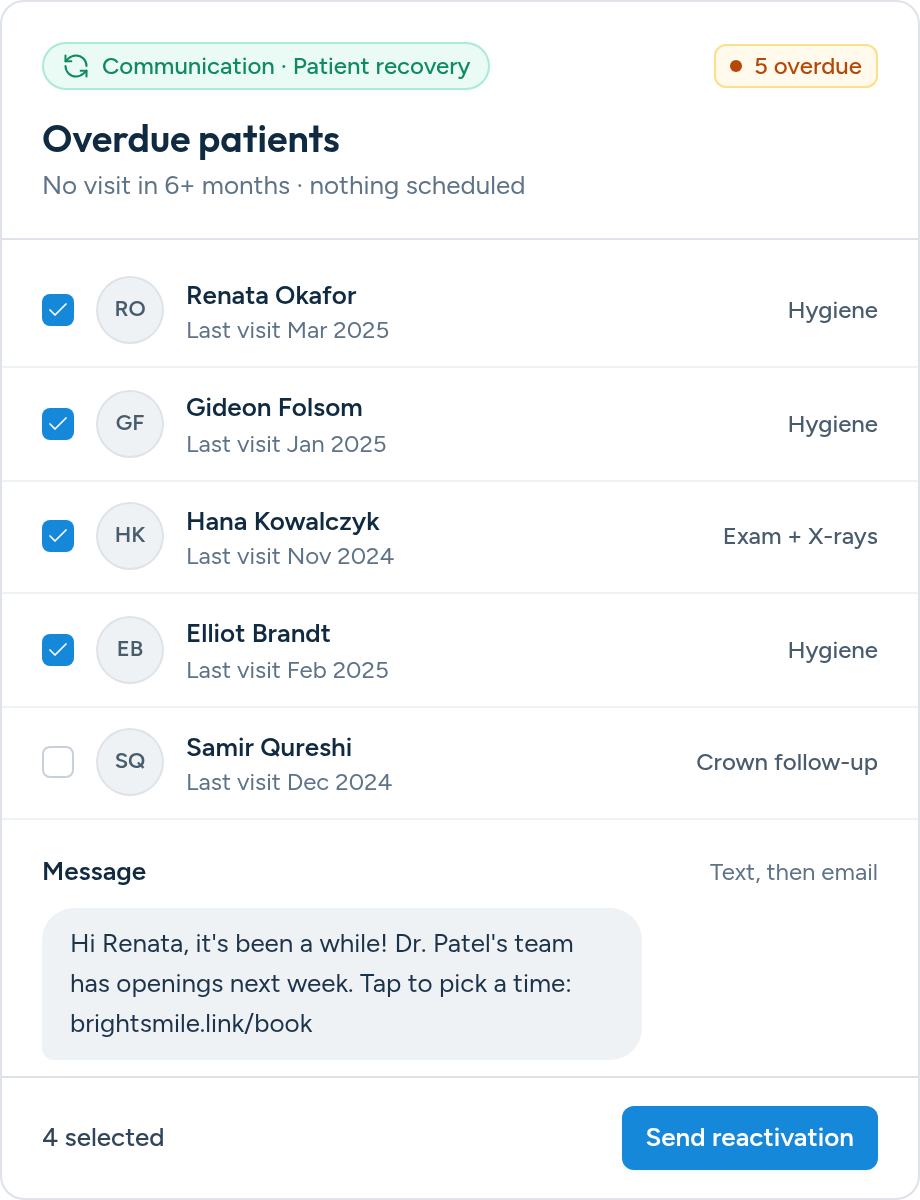
Send personalized email or SMS campaigns using proven dental reactivation templates.
Monitor open rates, responses, and booked appointments. See exactly how much revenue you've recovered.
Included
Every tool you need to reactivate your inactive patient base
Patient reactivation is the work of bringing back people who used to come to your practice and stopped. Every dental office has them, usually far more than the owner expects. A practice that has been open a decade routinely has a thousand or more charts that haven't been touched in over a year, each one a person who already trusts you enough to have sat in your chair.
Compared with acquiring a new patient, reactivation is remarkably cheap. There is no advertising to buy and no trust to build from zero. The barrier is almost always operational: nobody has the time to comb through the practice management system, work out who is genuinely overdue, and write to them one at a time. So it doesn't get done, and the list quietly grows.
Aron does the combing. It reads your PMS, identifies who has lapsed, ranks them by what they're actually worth, outstanding balance plus unscheduled treatment plan value, and lets you send the right message to the right segment in a couple of minutes rather than a couple of afternoons.
Almost never because they picked a competitor. Usually one of these.
Each cause needs a different message, which is why segmenting the list beats blasting one "we miss you" email at everybody. A patient avoiding a balance needs a payment option mentioned. A patient with unfinished treatment needs the clinical reason it matters. A patient who simply forgot needs two appointment times.
These templates ship with Aron and fill in from your PMS. Edit freely, the merge fields handle the personalization.
Hi {{first_name}}, it's {{practice_name}}. We noticed it's been a while since your last cleaning. We have openings next week, want me to hold one for you? Or book here: {{booking_link}}
Hi {{first_name}}, {{practice_name}} here. We'd love to see you back. New patients often wait weeks for an exam, as an existing patient we can usually get you in within a few days. Reply YES and we'll find a time.
Hi {{first_name}}, this is {{practice_name}}. Dr. {{provider}} had recommended treatment we never got scheduled. Nothing urgent, but it's usually simpler and less expensive to handle sooner. Want us to send some times?
"Hi {{first_name}}, this is {{name}} from {{practice_name}}. I'm going through our schedule and noticed you're overdue for your cleaning, Dr. {{provider}} likes to see everyone every six months. I have Tuesday at 10 or Thursday at 3. Which works better?" Offering two specific times converts far better than asking whether they'd like to book.
{{first_name}}, your dental benefits reset on January 1, let's not waste them
We've missed you at {{practice_name}}. If something about your last visit didn't sit right, just reply and tell us. We'd genuinely like to fix it. And if life simply got busy, here's a link to grab a time that works: {{booking_link}}
Win them back, then keep them from lapsing again.
Outcomes
Automatically identify patients who haven't been seen in 6, 12, or 18+ months. No manual chart audits required.
Patients are ranked by outstanding balance and pending treatment value so you chase the highest-value reactivations first.
Trigger personalized reactivation email campaigns with proven templates. 'We miss you' messages that actually convert.
Works with the PMS you already use
Patient reactivation is systematically bringing back patients who were once active in your practice but have stopped coming, typically anyone whose last completed visit is more than six, twelve or eighteen months old. It is the cheapest growth available to a dental office: these people already know you, are already in your system, and don't need to be convinced you exist. Reaching them costs a fraction of what a new patient costs to acquire.
Aron syncs with your PMS and flags any patient whose last completed appointment is older than your chosen threshold (typically 6, 12, or 18 months). No manual chart reviews needed.
Rarely because they chose a competitor. The common causes are mundane: the six-month recall was never booked before they left, they changed insurance and assumed you're out of network, a treatment plan was presented and never scheduled, or an outstanding balance is quietly making them avoid the conversation. Each of those has a different message that works, which is why segmentation matters more than volume.
Recall is routine: a patient is due for their cleaning and you remind them. Reactivation is for patients who have already fallen out of that rhythm, often a year or more out, sometimes with unfinished treatment or a balance attached. Recall is a reminder; reactivation is a re-invitation, and it needs a warmer message and usually more than one touch.
Yes. We provide proven templates but you can fully customize the subject lines, body copy, and calls to action. You can also A/B test different messages.
Patients are ranked by a combination of outstanding balance, pending treatment plan value, and time since last visit. This ensures your team focuses on the highest-revenue opportunities first.
October through December is the strongest window, because unused annual insurance benefits expire on December 31 and that deadline gives the message a genuine reason to exist. January is the second-best, when benefits reset and deductibles are fresh. That said, a standing monthly campaign against your newly-lapsed list beats one big annual push.
Yes, both channels are supported. You can run email-only, SMS-only, or combined multi-touch campaigns depending on your preference and patient communication opt-ins.
Three touches over two to three weeks, across two channels, is the usual sweet spot, a text, then an email, then a phone call for the high-value names. Beyond that, response rates fall off and you start irritating people. Anyone who doesn't respond stays on the list for the next quarterly run rather than being messaged again next week.
Most practices see a 15-25% reactivation rate within the first 30 days. With outstanding balances factored in, practices typically recover $5,000-$15,000 in the first month.
Yes, and Aron enforces it. Outreach respects each patient's recorded communication consent and opt-out status, messages send from your own practice number, and every reply and opt-out is logged. Patients who have opted out of texting are routed to email or your call list instead.
Absolutely. All patient data is encrypted, HIPAA-aligned, and never shared with third parties. Aron acts as a HIPAA Business Associate.
Your lapsed patients are someone else's new patients. Bring them back before a competitor does.