AI Dental Insurance Verification: How It Works (2026)
Insurance verification is the most repetitive job at a dental front desk. AI dental insurance verification checks eligibility automatically, before the patient walks in.
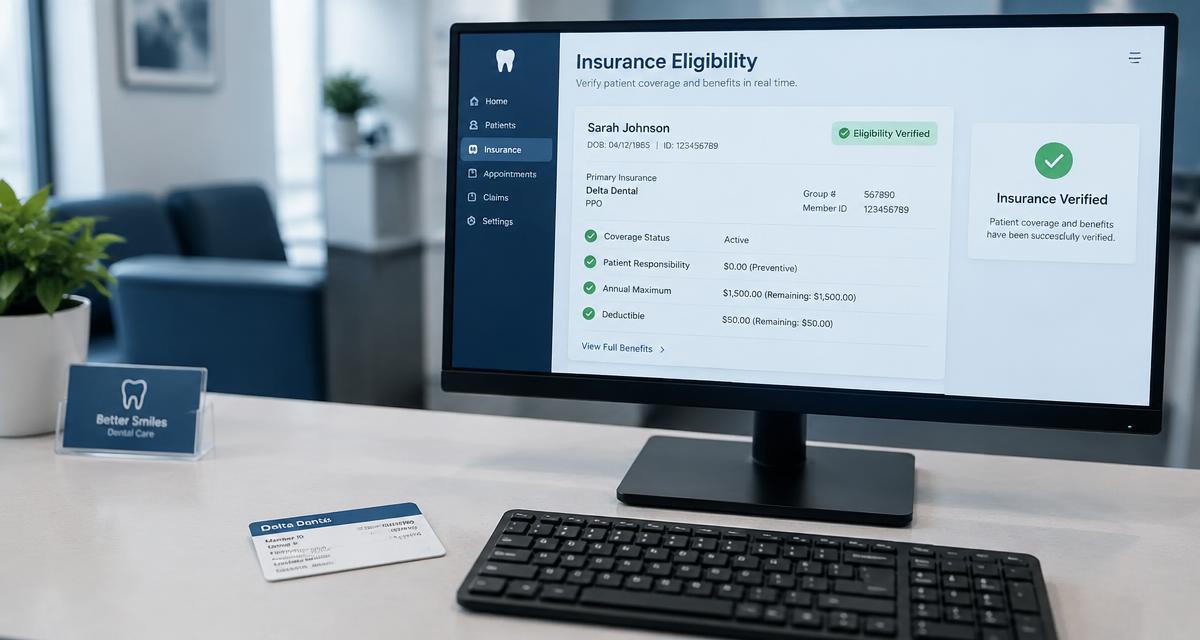
Insurance verification is the most repetitive job at a dental front desk. Someone logs into a payer portal or calls a carrier, reads off a member ID, and copies deductibles and frequencies into the chart. AI dental insurance verification does that work automatically, before the patient walks in.
TL;DR
- AI insurance verification sends an electronic eligibility request (an EDI 270) to the carrier and reads the 271 response back in seconds.
- Good systems run checks automatically the morning of the visit, not overnight, because many carriers go offline late at night.
- The AI part is turning the carrier's raw codes into plain answers: is the patient active, what's left of the maximum, what's covered for cleanings, fillings and crowns.
- Watch for: payers that don't return dental detail electronically, stale cached results, and tools that charge per check without telling you.
- Aron verifies eligibility automatically and puts a plain-English breakdown on the schedule.
What AI dental insurance verification actually is
Under the hood, nearly every automated system uses the same standard: the HIPAA eligibility transaction. Your software sends a 270 request (patient, subscriber, member ID, payer) through a clearinghouse, and the carrier answers with a 271 response. That response contains coverage status, plan dates, deductibles, annual maximums, coinsurance by service category and sometimes frequency limits.
The "AI" is what happens next. A 271 is a wall of service type codes and benefit segments. Software has to figure out which segment applies to a prophy versus a crown, whether "0%" means the patient pays nothing or the plan pays nothing, and which network tier applies. That interpretation is where most tools get things wrong, and where accuracy matters most.
How it works, step by step
- Pull tomorrow's and today's schedule from your practice management system (Open Dental, Dentrix, Eaglesoft and others).
- Collect the insurance on file for each patient: payer, member ID, subscriber and relationship.
- Send eligibility checks early in the morning, practice-local time, when carriers are online.
- Interpret the response into coverage status, remaining maximum, deductible and coinsurance by category.
- Flag problems: inactive coverage, wrong member ID, terminated plan, or a payer that needs a phone call.
- Retry carrier outages automatically instead of marking the patient as failed.
Manual vs AI verification
| Manual (portal/phone) | AI / automated | |
|---|---|---|
| Time per patient | 5-20 minutes | Seconds |
| When it happens | Whenever staff has time | Automatically before the visit |
| Errors | Typos, skipped patients | Mostly bad data on file |
| Coverage of edge cases | Good (a human can ask) | Needs a phone-call fallback |
Where AI verification still falls short
- Some payers return thin data. A few carriers return "active" with no dental breakdown. Those still need a portal look-up or a call.
- Bad inputs. A wrong date of birth or member ID gets rejected every time. Good systems stop re-checking the same bad record and ask staff to fix it.
- Coordination of benefits. When a patient has two plans, electronic data rarely says which is primary.
- Cost. Clearinghouses charge per check. Ask how pricing works before you turn on daily checks for every patient.
What to look for in a tool
- Checks run automatically in the morning, in your practice's time zone.
- Plain-English results on the schedule, not a PDF of codes.
- Correct handling of coinsurance percentages and service categories.
- Retries for carrier outages and no repeat checks on known-bad data.
- Results connected to the rest of the front desk: check-in, reminders and the phone.
For a ranked comparison of vendors, see the best dental insurance verification software in 2026. For the manual method, see how to verify eligibility in under 30 seconds.
How Aron handles it
Aron's insurance verification checks eligibility each morning at 6:00 AM practice-local time, retries carriers that are temporarily down, and shows coverage, remaining maximum and coinsurance next to each appointment in the Morning Huddle. The AI receptionist can collect insurance details from new patients on the call.
FAQ
Is AI insurance verification HIPAA compliant?
The underlying 270/271 transaction is the HIPAA standard. What matters is that the vendor signs a BAA and limits where patient data is stored.
Can it replace calling the carrier?
For most routine checks, yes. For frequencies, history and missing tooth clauses, some payers still require a call.
How early should checks run?
The morning of the visit, or the day before. Overnight runs often fail because carriers take systems offline late at night.
Book a demo to see verification on your own schedule.
Related: outsourcing vs software for insurance verification.