
Dental Answering Service: AI vs Live Answering (2026)
A complete 2026 comparison of live and AI answering services for dental practices: pricing, emergency triage, booking capability, and how to choose.
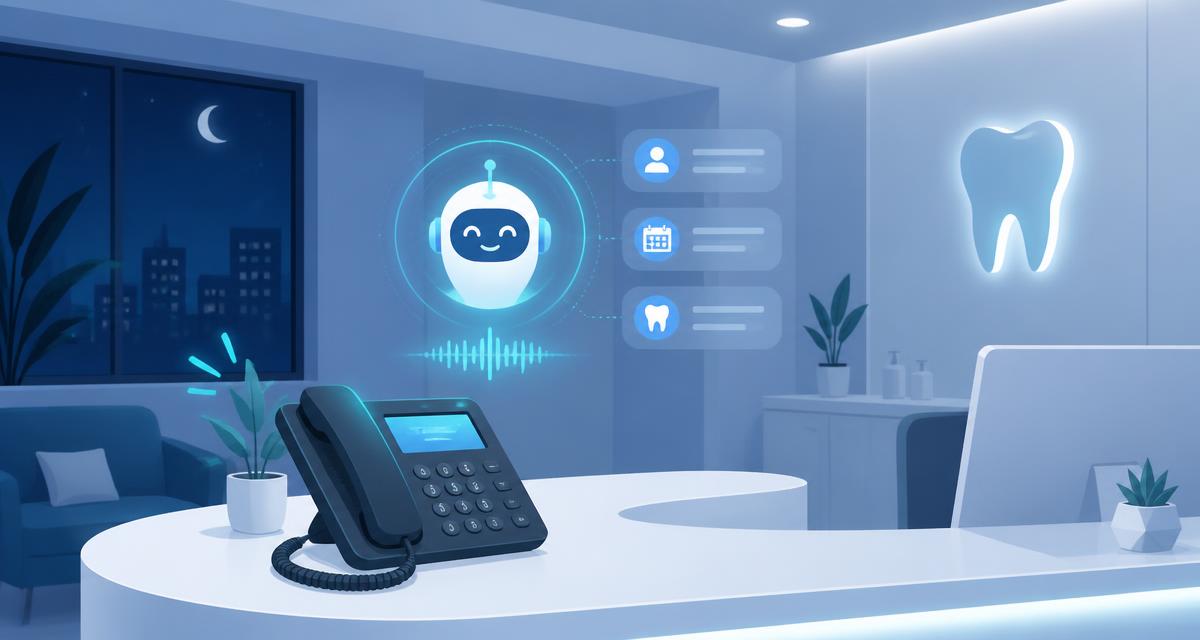
Every dental practice reaches the same breaking point. The front desk is checking in a patient, the second line rings, a third call rolls to voicemail, and nobody notices until later. A dental answering service is the traditional fix, and in 2026 there are two very different versions of it. This guide covers both honestly: what each does, what vendors publish about price, where each one falls short and how to choose.
A dental answering service answers the calls your front desk can’t reach. In 2026 there are two kinds: a live service, where a human agent answers with your greeting and takes a message or follows routing instructions, and an AI receptionist, which answers 24/7 and can book a real appointment directly into your practice software.
What are your options for answering dental calls after hours?
Dental offices have four main options for after-hours calls: voicemail, a live answering service, an IVR phone menu, or an AI receptionist. Only the last one books the appointment during the call.

Key points from the video
- Voicemail costs nothing, but many patients will not leave a message and someone has to listen and call back.
- A live answering service takes a message or follows a script; most cannot see your schedule, so they pass a note to your team.
- An IVR menu routes calls but patients often hang up on menus and it books nothing.
- An AI receptionist answers right away, finds the patient in your PMS and books a real open slot during the call. If a caller hangs up first, a missed-call text goes out so they can reply and book. Emergencies are escalated to your team.
- If you only need messages taken, a live service can work; if you want appointments on the schedule overnight, choose one connected to your PMS.
What vendors publish
| Vendor | Published entry pricing | Notes |
|---|---|---|
| Specialty Answering Service | $44/month plus $1.54/minute, or $159/month for 100 minutes | Provides a BAA; bills by the second; books through an online calendar |
| Abby | $164/month for 50 Abby Minutes; AI minutes count half | HIPAA options for human answering |
| Ruby | $250/month for 50 minutes, $395 for 100, $720 for 200, $1,725 for 500 | Billed in 60-second increments including hold; offers a BAA |
| Smith.ai (human) | $300/month for 30 calls, $810 for 90, $2,100 for 300; overage $8.50-$11.50 per call | Says it is not HIPAA compliant and can't handle protected health information |
See Aron pricing to compare an AI receptionist plan against the services above.
Prices below come from each vendor's own pricing page, or from the named third-party sources, as of October 2026. Confirm current terms in writing.
TL;DR
- A dental answering service answers calls your office can't, under your practice's name.
- Live services bill by the minute or call. Published entry prices run from about $44 a month plus $1.54 a minute (Specialty Answering Service) to $300 a month for 30 calls (Smith.ai) and $250 for 50 minutes (Ruby).
- AI answering is usually flat or credit-based. Aron's AI receptionist is included in plans from $399 a month, with no per-minute charges.
- The deciding factor is booking, not the voice. A message creates a callback task. A booked appointment creates revenue.
- Emergency handling needs a written protocol whichever you choose.
- Check HIPAA: some services do not sign a BAA, and some limit it to higher plans.
What is a dental answering service?
It is an outsourced phone-answering layer. Calls your office doesn't pick up, because you're closed, at lunch, in a huddle or on other lines, route to the service instead of voicemail. The service greets the caller as your practice and either resolves the call, escalates an emergency or passes a message back.
Practices use one for four reasons:
- After-hours coverage: patients in pain call at night and on weekends.
- Lunch and huddle gaps: when the fewest people are at the desk.
- Overflow: Monday mornings and the day after a holiday.
- New-patient capture: someone calling several offices books with whoever answers first.
A service is not a replacement for your front desk. It is a backstop for the calls your front desk can't reach.
Option 1: a live (human) answering service
How it works
You forward your line on a schedule or on no answer. An agent picks up with your greeting, asks scripted questions and follows your routing instructions.
Sources: vendor pricing pages and Onfolio, Back Office Bench and DocVA summaries, October 2026. Add-ons, holiday fees and overage rates differ, so get an itemized quote.
Strengths
- Real empathy for a patient in pain or a parent calling about a child.
- Judgment when a call goes somewhere a script didn't plan for.
- Fast to launch, because it is mostly call forwarding.
Weaknesses for dental practices
- Many can't book into your schedule. The result is a message and a callback, and some callers have already booked elsewhere.
- Shallow practice knowledge. An agent who covers many businesses may not know your insurance, fees or protocols.
- Cost can rise with volume. If your marketing works, your bill grows.
- Hold times and quality can vary at busy hours.
Option 2: an AI answering service
An AI answering service replaces the agent with a voice AI that converses naturally and completes tasks. With a dental platform connected to your PMS, that includes checking live availability and writing the appointment into your schedule while the patient is still on the line.
What Aron's AI receptionist does
- Answers 24/7, including when every line is busy.
- Books into your PMS according to your scheduling rules (Dentrix, Eaglesoft, Open Dental, Curve, Denticon and others).
- Answers in English, Spanish and Russian, and other common languages can be added on request.
- Flags emergency calls, and your office is notified.
- Records calls with a consent notice, which Aron handles, and gives your team a summary and transcript.
Pricing
AI answering is usually flat monthly, credit-based or per call. Smith.ai's AI plans list $150 for 75 calls, and RingCentral's AI Receptionist lists $49 a month for 100 minutes, then $0.50 per minute. Aron's AI receptionist is included in Basic ($399 a month) with four phone lines (handsets sold separately), Pro is $799 and Elite is custom, with no per-minute charges and no long-term contract. The question to ask any vendor: what is billed on top of the base fee?
Weaknesses
- Emotionally charged calls still belong with a person.
- Setup quality decides everything. If provider hours and appointment types are wrong, the AI will offer times you can't honor.
- Poor cell connections and heavy background noise cause occasional misunderstandings.
- It needs a supported PMS for the booking that makes it worth buying.
Live vs AI at a glance
| Factor | Live answering | AI answering |
|---|---|---|
| Cost model | Per minute or per call | Flat, credits or per call, depending on vendor |
| Hours covered | Often extra at night and weekends | 24/7 |
| Simultaneous calls | Limited by staffing | Not limited by staffing |
| Books into your PMS | Often not | Yes, with a dental platform |
| Emergencies | Agent follows your script | Flagged, and the office is notified |
| Empathy on hard calls | Strong | Should hand off to a person |
| Recordings | Varies | Every call, with summaries and transcripts |
| Setup | Days | Depends on PMS connection |
The metric that decides it: messages vs booked appointments
Pull your last 30 days of after-hours and overflow calls and split them into calls that produced a scheduled appointment and calls that produced a message. A message is a callback task, and callbacks decay by the hour. Someone who called several dental offices at lunch books with the one that gives a time on the call.
An example with made-up numbers: if you miss 40 calls a month, 20% are new patients and a new patient is worth $900 in first-year production, that is eight possible new patients and about $7,200 in production. Substitute your own figures. A service that books six of them is worth more than one that leaves eight messages, whichever one has a human voice.
Ask every vendor: "What share of after-hours calls end in a scheduled appointment, and can I hear the recordings?"
Emergency triage
Whichever route you pick, document the protocol.
Reach the on-call dentist immediately
- A knocked-out permanent tooth, because minutes matter.
- Uncontrolled bleeding after an extraction.
- Facial swelling, especially near the eye or under the jaw, or any trouble swallowing or breathing.
- Trauma with a fractured or displaced tooth.
- Post-operative complications with fever.
Can wait for the next business day
- A lost crown, filling or temporary without significant pain.
- A loose orthodontic appliance with no injury.
- Sensitivity or mild discomfort.
- Routine questions about medication or post-op care.
If the caller thinks it's an emergency, treat it as one. Neither an agent nor an AI should overrule the patient's own assessment.
HIPAA and consent
A service that hears patient information is a business associate and needs a signed BAA. Check whether the BAA is available on the plan you are buying, how recordings are stored and for how long, and how call-recording consent is handled in your state. Aron handles consent, and recorded calls include a consent notice.
Answering service or another front desk hire?
At the BLS median wage for receptionists ($38,010, May 2025) and benefits at 30% of private-industry compensation (BLS, June 2026), one full-time hire costs roughly $54,000 a year, covers business hours and handles one call at a time. A service handles the hours and calls a person can't. Many practices add a service and use their team's time on treatment presentation and insurance work.
If you want a wider view beyond dentistry, this guide to answering service for small business options is a solid cross-check.
How to choose
A live service fits if
- Call volume is low and irregular.
- Your first call on a case is a consultative conversation.
- You are not ready to give any outside system write access to your schedule.
- You need a language your AI vendor doesn't support.
An AI service fits if
- You lose calls at lunch, during huddles and after hours.
- You run paid ads and need every inbound call answered.
- You want recordings, transcripts and measurable bookings.
- You use a PMS the vendor integrates with.
Use both if
You are a growing practice or small group. AI answers first and books routine calls. Emergencies and emotionally difficult calls go to a person.
Ten questions to ask before signing
- Do you book into my PMS, or take messages?
- Which PMS systems do you integrate with, and is the connection live?
- What is your written emergency protocol, and can I change it?
- How quickly does an emergency reach my on-call dentist, and what is the backup?
- Is pricing flat, per call or per minute? Do you bill hold and wrap-up time?
- Are there holiday, after-hours or language surcharges?
- Will you sign a BAA on the plan I'm buying?
- Can I hear three real recordings, including one that went poorly?
- What is the term, and how does cancellation work?
- Who configures hours, providers and appointment types, and how long does it take?
Frequently asked questions
What is a dental answering service?
A dental answering service answers calls your practice can't, after hours, at lunch or during overflow, using remote human agents, voice AI or both. It greets callers as your practice, handles routine questions, escalates emergencies according to your protocol, and either books the appointment or passes a message to your team.
How much does a dental answering service cost?
It depends on the vendor and the model. As of October 2026, Ruby lists $250 a month for 50 minutes and $1,725 for 500, Smith.ai's human plans list $300 for 30 calls and $810 for 90, Specialty Answering Service lists $44 a month plus $1.54 a minute, and Abby lists $164 a month for 50 Abby Minutes. Aron's AI receptionist is included in plans from $399 a month, with no per-minute charges.
Can an answering service book dental appointments?
Many live services take messages or book through a calendar tool, not your practice management system. Aron's AI receptionist books into Dentrix, Eaglesoft, Open Dental, Curve and Denticon, among 17+ systems, according to your scheduling rules.
Is an AI answering service better than a live one?
For routine calls that end in a booking, AI is usually the better default. Live agents are better for calls that need empathy or judgment. Many practices use AI first and route sensitive calls to a person.
How does a dental answering service handle emergencies?
Through a written protocol you define. Aron's AI receptionist flags emergency calls and your office is notified, so a person at your practice hears about it quickly. Whichever service you pick, document who is called, in what order and what happens if no one answers.
Do answering services need to be HIPAA compliant?
Yes. A service that handles patient calls is a business associate and should sign a BAA. Some vendors do not: Smith.ai says it is not HIPAA compliant, and some services offer BAAs only on higher plans. Aron is HIPAA-aligned and we sign a BAA.
Can an answering service handle Spanish-speaking patients?
Live services often offer bilingual agents, sometimes at a surcharge or on limited shifts. Aron's AI receptionist answers in English, Spanish and Russian, and other common languages can be added on request.
Who handles call-recording consent?
Aron does. Recorded calls include a consent notice. If you use another service, ask how it handles consent for your state.
Should I use an answering service or hire another front desk person?
They do different jobs. At the BLS median wage for receptionists ($38,010, May 2025) and benefits at 30% of private-industry compensation (BLS, June 2026), a full-time hire costs roughly $54,000 a year and covers business hours, one call at a time. A service covers the hours and the calls a person can't.