
Buying an Existing Dental Practice vs. Starting From Scratch: The 2026 Decision Guide
A detailed, data-backed 2026 comparison: buy an existing dental practice or build a de novo? Financing, cash flow, ramp time, risk, and how to decide.
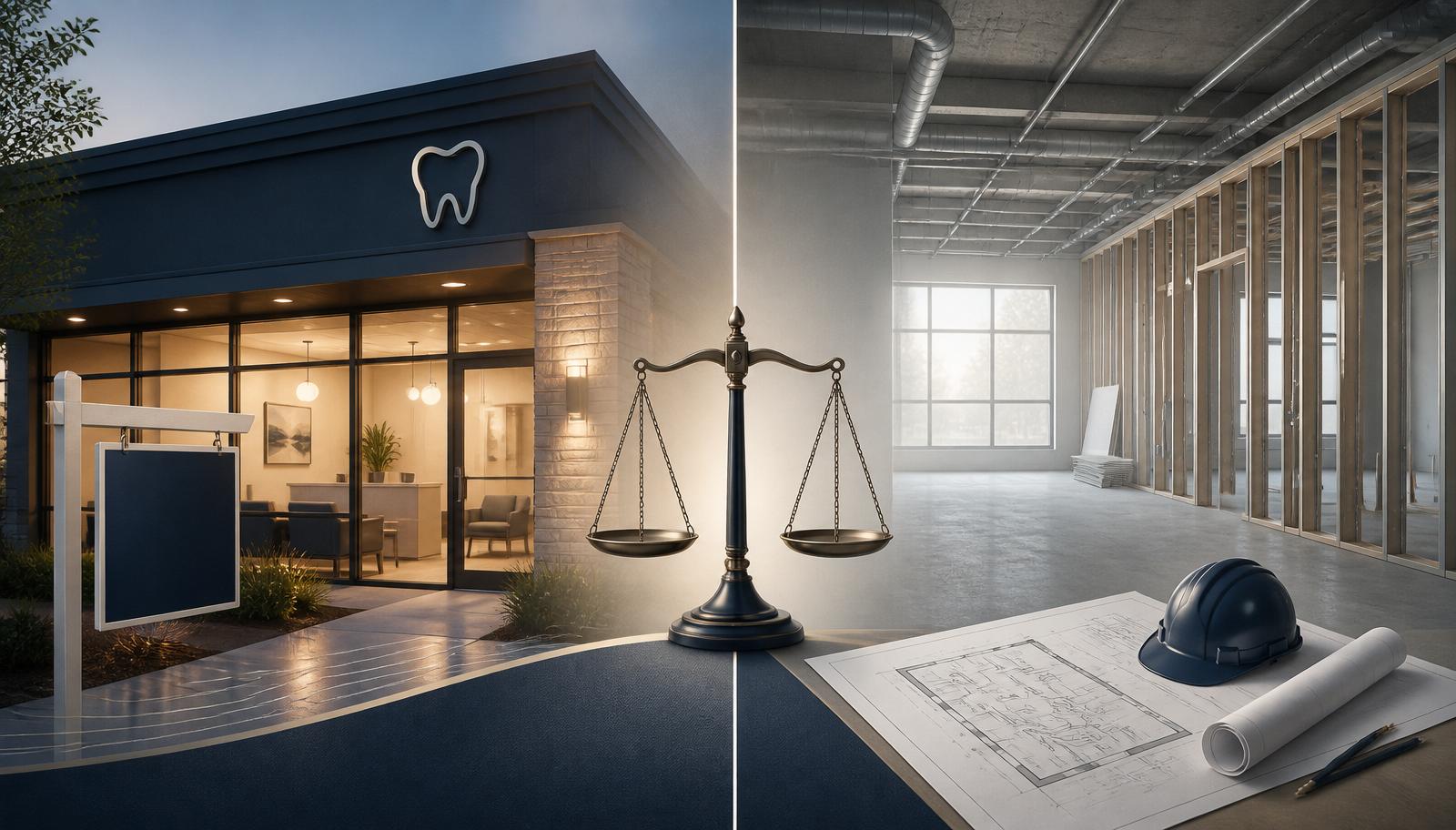
Should you buy an existing dental practice or start one from scratch? It's the single biggest financial and lifestyle decision most dentists will make in their career, and the right answer depends less on conventional wisdom and more on your capital, risk tolerance, location, and how fast you want to be cash-flow positive.
TL;DR
- Buying an existing practice is faster to cash flow (usually within 30–90 days), easier to finance (banks love the historical P&L), and lower risk, but you inherit the seller's systems, staff, and reputation, good or bad. Average acquisition price in 2025–2026 sits around 70–85% of trailing-12 collections, with most US practices selling for $500K–$1.5M+.
- Starting from scratch (a "de novo" or "startup") gives you a fully customized practice with modern tech and your culture from day one, but expect 12–24 months to break even, $450K–$750K+ in build-out and equipment, and the marketing burden of acquiring every patient yourself.
- Financing: banks like Bank of America, Live Oak, Lendeavor (now Provide), and Huntington routinely offer 100% financing for both paths to qualified dentists, but rates and terms favor acquisitions.
- The honest rule of thumb: if you want predictable income and have less than 2 years of clinical experience, buy. If you have a strong personal brand, an underserved area, and runway to wait 18 months, build.
- Hybrid path most people miss: buy a small, undervalued practice and then remodel/rebrand it. You get the patient base and cash flow of an acquisition with most of the upside of a startup.
Why this decision matters more than ever in 2026
Three forces have reshaped this decision in the last 24 months:
- DSO consolidation. Dental Service Organizations now own roughly 30–35% of US practices (up from ~10% a decade ago), and they're aggressively bidding up acquisition prices in metros, pushing some practices to 90%+ of collections. This makes startups relatively more attractive in saturated markets.
- Higher interest rates. SBA 7(a) and conventional practice loans are running roughly 8.5–11% in 2026, vs. sub-5% during the cheap-money era. Every extra point of interest hits acquisitions harder because the loan principal is bigger.
- Build-out inflation. Construction costs for a 5-op office are up 30–45% since 2019. A startup that penciled at $450K in 2019 is closer to $625K today, even before equipment.
None of this makes one path universally "right." It does mean you have to actually run the numbers for your situation instead of relying on what your mentor did in 2014.
The case for buying an existing practice
1. Cash flow on day one
The single biggest reason most dentists buy: you collect money the first week you own the practice. An established practice with 1,200+ active patients and a hygiene schedule already pays the bills, your salary, and the loan payment from month one. According to a 2025 ADA Health Policy Institute brief, the median time-to-positive-cash-flow for an acquired practice is under 60 days, versus 14–18 months for a de novo.
2. Financing is easier
Lenders underwrite acquisitions on the seller's tax returns and production reports. That's historical data, which banks love. Most well-qualified dentists with $0 down and decent credit can secure 100% financing on a $1M practice with a 10-year amortization and a 90-day working capital line on top. For a startup, the same lender wants a detailed business plan, demographic study, signed lease, and projections, and they'll often require 5–10% down plus more personal guarantees.
3. Built-in staff, systems, and patient relationships
Hiring a dental assistant or hygienist in 2026 is brutal, wages are up 20–35% since 2020 and most metros are still short-staffed. Inheriting an experienced team that already knows the patients is a massive head start. So is having an established Google Business Profile with 200+ reviews, an existing PMS database, and contracts with the major PPOs.
4. Lower failure rate
Practice acquisitions have a failure rate well under 5% when properly underwritten. De novos, while still successful overall, run closer to 10–15% in the first five years depending on location and market saturation.
The downsides of buying
- You inherit the seller's baggage. Old equipment, an outdated PMS, a difficult office manager who's been there 22 years, a fee schedule that hasn't moved since 2018, or PPO write-offs eating 40%+ of production.
- Patient attrition. Expect to lose 10–20% of active patients in the first year as the seller transitions out. A bad transition can push that to 30–40%.
- You're paying for goodwill. Most of an acquisition price is intangible, meaning if patients leave, that "asset" walks out the door.
- Cultural lock-in. Changing the personality of a practice that's been the same for 25 years is slow, sometimes impossible without losing the staff.
The case for starting from scratch
1. Total customization
Every operatory, every monitor placement, every software choice, the entire fee schedule, the brand, the patient experience, all yours. If you've worked as an associate in a poorly run practice, this freedom is intoxicating (and often the real reason dentists go de novo even when the math says buy).
2. Modern tech stack from day one
Cloud PMS (Curve, Denticon, or Open Dental in the cloud), CBCT, intraoral scanners, AI radiograph reading, paperless intake, and an integrated front-office platform that handles AI reception, insurance verification, and recall in one place. Retrofitting all of this into an acquired practice is doable but slow and politically painful with legacy staff.
3. You choose the demographics
A proper demographic study (Scott McDonald, Wassmuth, or your bank's free study) lets you plant your flag in a growing zip code with the right insurance mix and limited competition. The best acquisition in the wrong neighborhood will still underperform a thoughtful startup in a great one.
4. No goodwill payment
Every dollar you borrow goes into a tangible asset, equipment, build-out, cabinetry, technology, not the intangible "name and reputation" of the previous owner. If the practice fails (it usually won't), you can liquidate the hard assets at 40–60% of cost. Goodwill on a failed acquisition is worth $0.
The downsides of starting from scratch
- The ramp is brutal. Most de novos do $300K–$500K in year-one collections, $600K–$900K in year two, and don't hit "mature" numbers until year 3–5.
- You need real marketing chops (or to outsource them well). Patient acquisition cost for a new dental practice runs $150–$400 per new patient through Google Ads, Meta, and direct mail combined. Without a system, this gets expensive fast.
- Cash burn before cash flow. Plan on $50K–$150K in working capital just to cover payroll, rent, and your living expenses until collections catch up.
- Hiring from zero. No inherited team. You're recruiting in a tight labor market with no production yet to pay competitive wages.
Side-by-side comparison
| Factor | Buy Existing | Start From Scratch |
|---|---|---|
| Typical total capital required | $500K–$1.5M+ (financed) | $450K–$750K+ (financed) |
| Time to positive cash flow | 30–90 days | 12–24 months |
| Year-1 collections (median) | $900K–$1.4M | $300K–$500K |
| Financing difficulty | Easy, 100% loans common | Harder, more docs, sometimes down payment |
| Patient base | 1,000–3,000+ active inherited | 0, you build from scratch |
| Staff | Inherited (mixed blessing) | You hire from zero |
| Customization | Limited; transition friction | Total |
| 5-year failure rate | ~5% | ~10–15% |
| Best fit for | Risk-averse, needs income fast, less experienced | Strong brand, underserved market, longer runway |
The numbers: a realistic 5-year P&L comparison
Hypothetical, but representative of what banks actually model. Both scenarios assume a single doctor, ~5 ops, suburban US market, 10-year loan at 10% interest.
Scenario A: Buy a $1.2M practice (sold at 80% of collections, $1.5M trailing)
- Loan: $1,200,000 at 10% / 10yr → ~$15,860/mo debt service ($190K/yr)
- Year 1 collections: $1,400,000 (5% transition dip)
- Overhead (excl. debt + doctor comp): 60% → $840,000
- EBITDA before debt and owner: ~$560,000
- After debt service: ~$370,000 owner take-home year 1
- 5-year cumulative owner comp (modest 3%/yr growth): ~$2.1M
Scenario B: Build a $625K de novo
- Loan: $700,000 (build + working capital) at 10% / 10yr → ~$9,250/mo debt service ($111K/yr)
- Year 1 collections: $400,000
- Year 1 overhead (high due to fixed costs on low revenue): 90%+ → break-even or small loss
- Owner draw year 1: ~$60K–$90K (often from working capital line)
- Year 3 collections: $950K, mature overhead 58% → owner take-home ~$300K
- 5-year cumulative owner comp: ~$1.1M–$1.4M
- But: by year 5, equity in a debt-free, custom-built practice is often worth more than an acquired one at the same revenue, because there's no goodwill on the books.
Translation: the acquisition wins on near-term cash. The startup catches up on enterprise value over 7–10 years, and can leapfrog if you're a great marketer or operator.
How to decide: a 7-question gut check
- How much clinical experience do you have? Under 2 years out of school → strongly favor buying. You'll learn business and clinical at once; a turnkey patient base buys you margin for error.
- What's your monthly personal burn rate? Student loans + family + mortgage = need income fast = buy.
- Is your target zip code saturated? Run a free demographic report. If the dentist-to-population ratio is below 1:1,500, startups are tough. If it's above 1:2,500, startups thrive.
- Are you a natural marketer / strong personal brand? Honest answer. If you've built an Instagram following, run successful ads, or have a referral network, you can fuel a de novo. If not, an acquired patient base does it for you.
- How much working capital can you actually access? Banks will lend the build, but you need $50K–$150K liquid for living expenses + ramp. If that doesn't exist, buying is safer.
- Do you have a non-negotiable vision? If you want to be a fully fee-for-service, holistic, all-ceramic practice, buying a 100% PPO mill and converting it is a 5-year project. Starting from scratch is faster.
- What does your spouse / partner want? Don't underestimate this. Two years of $90K income and 60-hour weeks is hard on a household that expected $300K.
The hybrid path: buy small, then rebuild
Often the smartest play that nobody talks about: buy a smaller, undervalued practice ($400K–$700K collections), then invest in modernizing, marketing, and growing it. You get:
- Day-one cash flow (just enough to cover debt + modest salary)
- An existing patient base to grow from
- Room to remodel, rebrand, and install your tech stack within 6–18 months
- Lower entry price means lower goodwill risk
- Massive upside, taking a $500K practice to $1.5M in 4 years is very achievable with good systems
This is also the path most DSOs use at scale, because the math is so good.
What to look for if you're buying
- Trailing 3-year collections trend. Flat or growing = good. Declining = ask hard questions.
- Active patient count (visited within last 18–24 months). 1,000+ is healthy for one full-time doctor.
- Hygiene production %. Should be 25–35% of collections. Below 20% means the recall system is broken (often a hidden upside if you fix it).
- PPO mix and write-off %. Pull the adjustments report. Anything above 35% writeoffs deserves a plan.
- Lease terms. Will the landlord extend? At what rate?
- Staff intentions. Talk to the team (with the seller's permission) before closing. Losing the hygienist on day 30 wrecks the model.
- Online presence. Google reviews, website, social. These come with the practice and matter more than ever.
What to look for if you're starting from scratch
- Demographics. Pay for a real study. Population growth, median income, insurance mix, competitor density.
- Visibility. Street-front retail beats the office park, especially in year 1–2.
- Lease. Free rent during build-out (typically 3–6 months) and a TI (tenant improvement) allowance of $40–$80/sf.
- Equipment financing structure. Some lenders separate real estate, equipment, and working capital tranches at different rates.
- Marketing budget. Plan $8K–$15K/month for the first 18 months across SEO, Google Ads, Meta, and direct mail.
- Front-office stack. Get your AI receptionist, online booking, recall, and reviews automation in place before you open. The practices that ramp fastest treat the first call like the first impression, because it is.
Where Aron fits in
Whether you buy or build, the front office is what determines how fast new patients turn into booked, kept appointments, and that determines whether year one looks like a celebration or a panic.
Aron is the all-in-one front-office platform built specifically for independent dental practices: 24/7 AI receptionist, two-way SMS, automated insurance verification, recall and reactivation, reviews, and a modern website, all connected directly to your practice management system. For acquired practices it's the fastest way to modernize without ripping out your staff's existing workflow. For de novos it's the difference between answering 100% of your first 500 calls, and missing the third of them that fund your loan payment.
Book a 15-minute walkthrough and we'll show you exactly what year-one ROI looks like in your zip code.
FAQ
How much does it cost to buy a dental practice in 2026?
Most US general dental practices sell for 70–85% of trailing-12 collections. In major metros and competitive DSO markets, multiples can hit 90–110%+ of collections, or roughly 5–7x EBITDA. Expect total deal sizes between $500K and $1.5M+, with specialty practices (oral surgery, endo, perio, ortho) often higher.
How much does it cost to start a dental practice from scratch?
Plan for $450K–$750K+ for a 4–6 op de novo in 2026, depending on metro, build-out finishes, and equipment choices (CBCT and CAD/CAM add quickly). Add another $50K–$150K in working capital for living expenses during ramp.
Can I get 100% financing for either?
For acquisitions: yes, routinely, for qualified dentists with decent credit. For de novos: often yes, but lenders may want 5–10% down or extra collateral. Top lenders include Bank of America Practice Solutions, Live Oak Bank, Provide (formerly Lendeavor), Huntington National Bank, US Bank, and Wells Fargo Practice Finance.
How long until a startup dental practice is profitable?
Most de novos hit break-even at 12–18 months and reach "mature" production at 3–5 years. The best operators with strong marketing systems can compress this to 9–12 months; underperformers can take 3+ years.
What's a fair multiple to pay for a dental practice?
The market in 2026 sits around 0.7–0.85x trailing collections for owner-operator buyers and 0.9–1.1x for DSO buyers. On an EBITDA basis, 4–6x is typical for individual buyers, 6–8x+ for DSOs on attractive practices.
Is it harder to start a dental practice today than 10 years ago?
Yes, higher interest rates, higher build-out costs, tighter labor market, and more saturated metros. But it's also easier in some ways: cloud PMS, AI front-office tools, online booking, and digital marketing let a solo practice run lean and look established from day one. The bar is higher; the tools are better.
Should I work as an associate first?
For most new graduates, yes. 1–3 years as an associate builds clinical speed, business literacy, and savings. Going straight from school to ownership works for a small percentage of dentists, usually those with family in the business or a strong mentor.
What's the biggest mistake first-time owners make?
Underestimating overhead and front-office leakage. A practice doing $1M with a great clinical team but a phone that goes to voicemail and no recall system can easily leave $300K/year on the table. Fix the front office before you scale the chair time.
The bottom line
There's no universal answer, but there is a right answer for you. Buy if you need income now, want lower risk, have less experience, or have found an undervalued practice in a good market. Build if you have runway, a strong brand or marketing engine, a clear vision the market doesn't currently offer, and an underserved zip code to plant a flag in.
Whichever path you pick, the practices that win in 2026 are the ones with modern operations from day one, a stack that answers every call, books every patient, verifies every insurance, and brings every overdue patient back. That part doesn't change whether you bought it or built it.