
AI Receptionist Cost for Dentists (2026): Is It Worth It?
Every unanswered call after 5 pm is a new patient who calls the next office on Google. Aron's AI receptionist answers 24/7, offers real open slots and books them straight into your PMS, starting at $399/mo with no long-term contract.
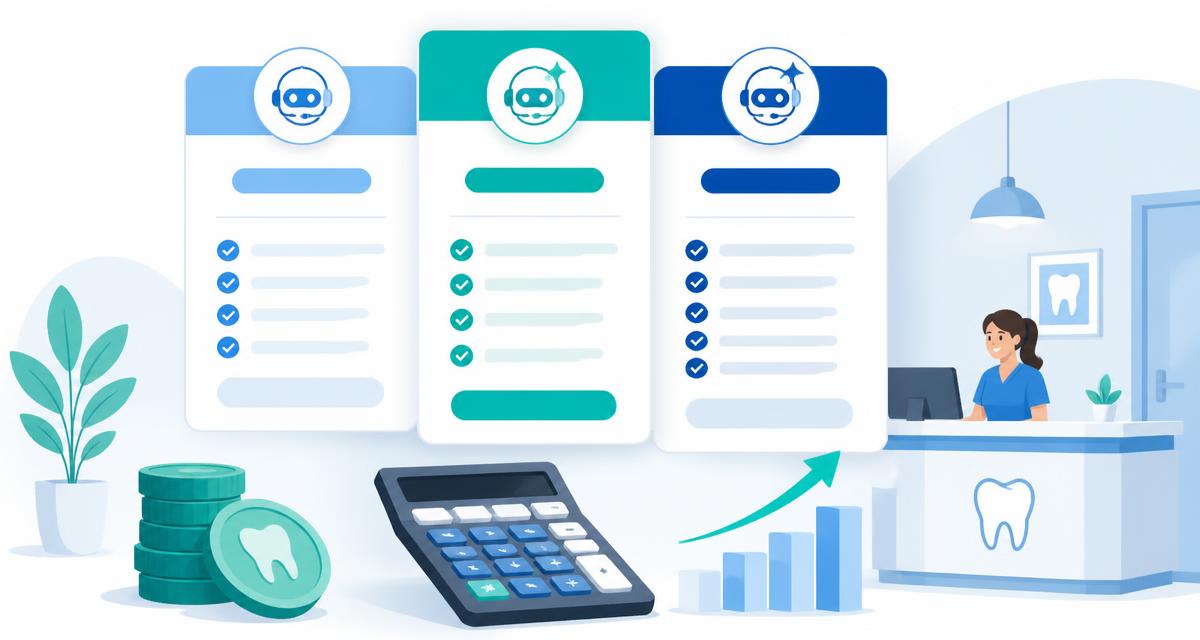
Every unanswered call after 5 pm is a new patient who calls the next office on Google. Aron's AI receptionist answers 24/7, offers real open slots and books them straight into your PMS, starting at $399/mo with no long-term contract. Explore Aron's AI receptionist for dental practices.
Pricing in the AI receptionist market is deliberately hard to compare. Some vendors publish a flat monthly number. Some publish a low base fee and bill per minute on top. Some publish nothing at all and route you to a sales call. And almost none of them make it obvious what happens to your bill when your call volume doubles.
This guide lays out what dental practices actually pay in 2026: the pricing models in use, real ranges by tier, every fee that tends to show up after signing, how AI compares to the alternatives, and how to calculate whether it pays for itself in your specific practice.
TL;DR
- Dental AI receptionists are priced three ways: a flat monthly fee, per-minute usage, or a base fee plus usage. Flat is the easiest to budget when marketing makes call volume spike.
- Most vendors don't publish prices, and ranges quoted online are estimates. Get a written quote that covers your call volume.
- Ask about setup fees, per-minute overage, per-location fees, PMS integration charges, text-message costs, extra languages or agents, outbound calling and contract length.
- Aron: Basic $399/mo, Pro $799/mo, Elite custom. Flat, with no per-minute charges and no long-term contract. Basic includes the AI receptionist and 4 phone lines (handsets sold separately).
- Break-even is a short calculation you can run with your own numbers (worksheet below). At an assumed $900 of first-year production per new patient, a $799 plan breaks even at about one new patient a month.
- Compare against what covers your phones today. At the BLS median wage for receptionists ($38,010, May 2025) and benefits at 30% of private-industry compensation (BLS, June 2026), one full-time hire costs roughly $54,000 a year and covers business hours only.
The three pricing models, and which one dentists should want
1. Flat monthly subscription
You pay a fixed amount per month per location. Call volume doesn't change the invoice.
Why it suits dental practices: Dental call volume is seasonal and campaign-driven. A direct mail drop, a Google Ads push, or a January insurance-reset surge can double your inbound calls in a month. Under flat pricing, a good month costs the same as a slow one. Under usage pricing, marketing success raises your phone bill, which is exactly backwards.
What to verify: that "flat" is genuinely flat. Ask directly whether there is any per-minute, per-call, or per-booking charge above a threshold, and get the answer in the contract.
2. Per-minute usage pricing
You pay for talk time, sometimes with a monthly minimum. Rates vary by vendor. As an example with made-up rates: a practice handling 500 calls a month at an average of 3.5 minutes uses about 1,750 minutes. At a hypothetical $0.20 a minute that's $350 a month. At a hypothetical $0.35 a minute with 800 calls it's $980. The model is fine at low volume and gets expensive when the system is working hardest.
Per-minute pricing is most common with general-purpose voice AI platforms, the ones not built for dentistry, which is also the category least likely to book into your PMS.
3. Hybrid: base fee plus usage
A monthly platform fee that includes a bundle of minutes, plus overage above the bundle. This is the model that produces the "why is my bill $1,400 this month" conversation.
If a vendor quotes hybrid pricing, ask for your projected all-in cost at 1.5x your current call volume. If they won't model it, treat that as an answer.
How the bill changes as call volume rises
Concept, not real quotes.
- Flat monthly: call volume doesn't change the invoice
- Per-minute usage: gets expensive when the system works hardest
- Base fee plus usage: overage above the bundle
- Flat monthly: call volume doesn't change the invoice
- Per-minute usage: gets expensive when the system works hardest
- Base fee plus usage: overage above the bundle
What Aron costs, and what each plan includes
| Plan | Price | What's included |
|---|---|---|
| Basic | $399/mo | 24/7 AI receptionist that books into your PMS, missed-call text-back, two-way texting, website chatbot, online booking, patient forms with PMS write-back, review requests and auto-replies, and 4 phone lines (handsets sold separately) |
| Pro | $799/mo | Everything in Basic plus real-time insurance verification (150 checks a month), claims tracking and payer status, A/R aging reports, a morning huddle, payment plans and payment links, and a Patient Recovery worklist |
| Elite | Custom | Everything in Pro plus automatic recall and reactivation by text and phone call, marketing ROI tracking, call tracking, SEO tracking, Google Ads management done for you, unlimited phone devices and multi-location reporting |
All plans include unlimited users, PMS integration, HIPAA-aligned security (we sign a BAA), onboarding and no long-term contracts. There are no per-minute charges at any tier.
How to read other vendors' quotes
Most vendors in this category don't publish prices, so the number you see in an ad is rarely the number on the contract. For every quote, write down five things: the monthly price, what is included in it, what is billed on top of it, the length of the term, and what the price is at renewal. Then compare vendors on the same call volume and the same number of locations.
Setup and onboarding fees
Setup fees range from nothing to a professional-services charge, depending on the vendor and how much configuration it does for you. Ask whether setup is included, what it covers, and whether it is charged again for each location. Aron's onboarding is included in every plan.
What onboarding should cover, whether or not you're billed separately for it: PMS connection and testing, provider hours and lunch blocks, appointment types with correct durations, operatory and chair rules, accepted insurance plans, in-house membership plan details, emergency triage and transfer rules, and at least one round of live test calls before you point real patients at it.
Practices that skip the schedule-configuration step are the ones that later complain the AI booked a patient at a time the office was closed. That isn't an AI problem, it's a setup problem, and it's the single highest-leverage hour of the whole implementation.
The fees that don't appear on the pricing page
- Per-minute overage. Ask for the exact included-minute bundle and the overage rate, then model a heavy month.
- Per-location fees. Multi-location practices are frequently quoted a per-office rate with no meaningful discount. Negotiate this, volume pricing exists.
- PMS integration fees. Some vendors charge a one-time or recurring fee for the connector to Open Dental, Dentrix, or Eaglesoft. That connector is the entire reason to buy the product; it shouldn't be an upsell.
- SMS and telephony pass-through. Confirmation texts and phone numbers cost real money. Ask whether messaging is included or billed at cost plus margin.
- Additional agents or voices. Running a separate agent for a second location or a Spanish-language line sometimes doubles the fee.
- Outbound calling. Recall, reactivation, and unscheduled-treatment follow-up calls are often a separate line item from inbound answering.
- Annual-only contracts. A discount for annual prepay is reasonable. Refusing to offer any monthly option is a signal about churn.
- Overage on "unlimited." Read the fair-use clause. Some unlimited plans have a soft cap that triggers per-minute billing.
- Support tiers. Confirm whether a human being will answer when the AI misbehaves on a Tuesday afternoon, or whether that's an add-on.
How AI receptionist pricing compares to the alternatives
| Option | What it costs | Coverage | Books appointments? |
|---|---|---|---|
| Voicemail | $0 | None | No |
| Live answering service | Quote-based; per-minute and monthly plans are common | Varies by plan; after-hours coverage is often extra | Usually takes messages |
| Additional front desk hire | About $54,000 a year in total compensation at the BLS median receptionist wage ($38,010, May 2025), with benefits at 30% of compensation (BLS, June 2026). More in high-cost cities. | Business hours, one call at a time | Yes |
| AI receptionist | Flat monthly fee on flat-priced plans; Aron starts at $399/mo | 24/7, with simultaneous calls | Yes, with PMS integration |
The hiring comparison deserves a note of honesty: an AI receptionist is not a substitute for a good front desk person. A great treatment coordinator who presents cases and works your recall list produces far more than $4,000 a month in value. The comparison that matters is against the calls nobody is answering at 7:40 PM, at 12:15 PM, and on the fourth simultaneous line Monday morning, hours no employee will cover.
For the category-level comparison, see AI receptionist vs. virtual receptionist and answering services for dental offices: AI vs. live.
Calculating ROI for your dental practice
Skip any vendor's ROI calculator and run your own with four numbers from your practice. Where the page gives a number below, it is an assumption for the example, not a benchmark.
Step 1: Count your missed calls
Pull the last 30 days from your phone system: unanswered calls, calls that went to voicemail, and calls abandoned on hold. Include the after-hours block, because that is often where the largest share sits.
Step 2: Estimate the new-patient share
Listen to a sample of voicemails and abandoned calls and count how many were new patients. If you can't, use 20% as a placeholder. Practices running paid ads or mailers often see a higher share.
Step 3: Use your real new-patient value
Use your own first-year production per new patient if you track it. The example below assumes $900. Specialty practices should use their own, usually higher, figure.
Step 4: Apply a conservative capture rate
An AI receptionist won't convert every missed call. Some callers are price shoppers, wrong numbers or people who want a person. The example below assumes it books 60% of new-patient calls it answers. Test calls will tell you more than any average.
Worked example (illustrative assumptions, not customer results)
- 50 missed calls a month (assumption)
- 20% new patients = 10 prospective new patients
- 60% capture = 6 booked new patients
- $900 first-year production each = $5,400 a month in recovered production
- Cost at $799 a month = about 6.8 times the cost
Break-even at these assumptions: a $799 plan needs about 0.89 additional new patients a month, and a $399 plan about 0.44. Elite is custom-priced, so its break-even depends on your quote.
Fill-in worksheet: (missed calls per month) x (new-patient share) x (capture rate) x (first-year production per new patient) = recovered production per month. Divide your monthly plan price by your production per new patient to get your break-even.
That is the inbound side only. It leaves out fewer no-shows from confirmations, recall appointments filled by outbound outreach, and the front desk hours returned to treatment presentation and insurance work.
New patients needed to break even
Illustrative assumption: $900 first-year production per new patient. Use your own number.
Elite is custom-priced, so it is not shown.
| Plan | New patients per month to break even |
|---|---|
| Aron Basic | 0.44 |
| Aron Pro | 0.89 |
Is an AI receptionist worth it for a small practice?
A missed new-patient call can be worth more than the flat monthly fee. Compare your own average new-patient value with your monthly plan.
Staff cannot answer every call during lunch, huddles and after hours. An AI receptionist can cover those gaps while your team stays focused on patients already in the office.
Illustrative, plug in your own numbers
| Monthly plan | Avg new-patient value | New patients needed to break even |
|---|---|---|
| $399 (Aron Basic) | $500 | 0.8 |
| $399 | $1,000 | 0.4 |
| $799 (Aron Pro) | $500 | 1.6 |
| $799 | $1,000 | 0.8 |
If your AI books even two new patients a month you are ahead; if it can't put appointments on your schedule, it's a voicemail with extra steps.
What should be included at every price point
Regardless of tier, don't accept a dental AI receptionist without:
- A signed BAA and documented HIPAA safeguards, see our HIPAA-aligned AI buyer's checklist
- Call recordings and full transcripts for every call, retained and searchable
- A defined transfer path to a human, with triggers you control
- Emergency triage rules you can write yourself
- Live PMS availability, not a cached copy synced overnight
- A month-to-month option, even if you choose to prepay annually
- Outcome reporting, booked, transferred, missed, voicemail, so you can measure what you bought. More on that in call analytics for dental practices.
How to negotiate
- Ask whether the setup fee can be waived on an annual commitment.
- Push for multi-location pricing. Locations two and beyond reuse the same configuration work.
- Request a 30-day out. Vendors confident in their product will grant a short escape hatch.
- Get the overage terms in writing even if you're on a flat plan, so "flat" stays flat at renewal.
- Ask for renewal-rate protection, a cap on year-two increases.
- Negotiate a pilot at one location if you're a group, with agreed success metrics before rollout.
The bottom line
A dental AI receptionist should be priced so your bill doesn't rise when your marketing works, and the PMS integration that makes the product worth owning shouldn't be an upsell. Judge it against the calls you're currently sending to voicemail, not against a theoretical employee. Run the worksheet above with your own numbers, and see it book a real appointment on your schedule before you decide.
Next: compare vendors in our 2026 buyer's guide to AI receptionists for dental offices and the top 10 dental AI receptionist platforms compared. If you're on a specific PMS, start with the best AI receptionist for Open Dental, Dentrix, and Eaglesoft, and if the phone system itself is up for renewal, see the best phone systems for dental offices in 2026.
Frequently asked questions
How much does an AI receptionist cost for a dental office?
Prices vary by vendor and most don't publish them, so get a written quote for your call volume. Aron's published plans are Basic $399/month, Pro $799/month and Elite custom, flat, with no per-minute charges and no long-term contract. Basic includes the AI receptionist and 4 phone lines (handsets sold separately).
Is AI receptionist pricing per minute or flat monthly?
Both models exist. Some vendors charge a flat monthly fee, some charge per minute of talk time, and some charge a base fee plus usage. Flat pricing is easier to budget because call volume rises when your marketing works. Aron is flat at every tier.
Are there setup fees for an AI receptionist?
It depends on the vendor. Ask whether setup is included, what it covers, and whether it is charged again for each location. Setup should cover PMS connection, provider hours and appointment types, emergency rules and live test calls. Aron's onboarding is included in every plan.
Is an AI receptionist cheaper than hiring a receptionist?
Usually, yes, but they do different jobs. The U.S. Bureau of Labor Statistics reports a median wage of $38,010 for receptionists (May 2025), and benefits made up 30.0% of private-industry compensation in June 2026. That works out to roughly $54,000 a year for one full-time hire, who covers business hours and one call at a time. An AI receptionist covers nights, weekends and simultaneous calls, and it works best alongside a good front desk.
How many new patients does an AI receptionist need to book to pay for itself?
Divide the monthly price by what a new patient is worth to your practice in first-year production. At an assumed $900 per new patient, a $399 plan breaks even at about 0.44 new patients a month and a $799 plan at about 0.89. Use your own number, and use the worksheet on this page.
What hidden fees should I watch for?
Per-minute overage above an included bundle, per-location charges, separate fees for PMS integration, text-message costs, extra charges for additional languages or agents, outbound calling billed separately from inbound, fair-use caps on "unlimited" plans, and annual-only contracts.
Do AI receptionists charge per location?
Many do. Group practices should ask for tiered pricing and a pilot at one location with agreed success measures before a full rollout.
Is there a free AI receptionist for dental offices?
Be cautious with free offers. Voice AI has real per-call costs, so a permanently free product is usually limited or paid for some other way. Whatever you pick, run real calls through it and read the transcripts. You can hear Aron's receptionist on our demo line at (917) 410-4750.
Should I sign an annual contract?
Only after you have run the product on live calls and checked that it books correctly against your actual schedule. Ask for the renewal terms and any price-increase cap in writing either way. Aron has no long-term contract.
Does AI receptionist pricing include the phone system?
Often it doesn't. Many AI receptionists use call forwarding and leave your existing phone bill in place. Aron Basic includes Aron's phone system with 4 phone lines for $399/month, and handsets are sold separately. Pro and Elite also include the phone system.
Does the AI receptionist work with my PMS?
Aron works with Dentrix, Eaglesoft, Open Dental, Curve and Denticon, among 17+ systems, and sends automated sync health alerts if a connection drops.