
AI Dental Marketing: The Complete 2026 Guide (Uses, Safety and ROI)
A plain guide to AI in dental marketing: what it does well, where it falls short, how to keep patient data safe, and how to measure results.
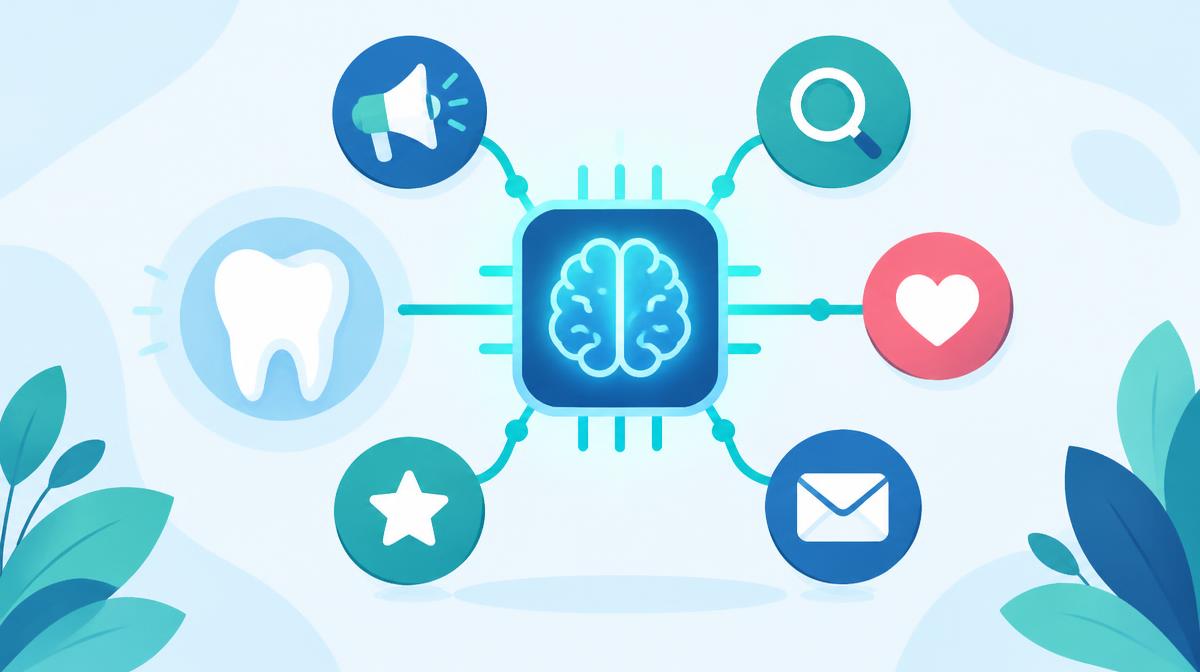
AI dental marketing means using AI to help with the work around attracting and booking patients: drafting website content, answering routine questions, preparing review replies, adjusting ad bids and making reports easier to read. The useful question is not whether a tool has AI. It is whether it solves a specific problem without creating a privacy or accuracy problem.
This guide explains where AI fits, where people still need to make the decisions, and how to evaluate it with your own practice data. My advice is simple: start with a task you can define, give the system clear boundaries, and check what happens before expanding.
TL;DR
- Use AI for drafts, routine conversations, ad optimization and reporting support. Keep people responsible for clinical information, exceptions and final decisions.
- Separate answering an inquiry from booking an appointment. Ask vendors to demonstrate exactly what reaches your practice management system.
- Before a vendor handles protected health information, get a signed business associate agreement and assess whether the workflow meets HIPAA requirements.
- Never paste patient information into consumer chatbots. Review AI-written content and public replies before publishing.
- Measure inquiries, bookings, attended appointments and costs separately. More activity is not proof of better marketing.
- Start with a limited workflow and a named staff owner. Do not buy a collection of tools before deciding how they will work together.
What AI dental marketing actually means
There are different jobs inside that label. Generative AI produces text, such as a draft FAQ or a suggested review response. Conversational AI handles questions through a phone or chat interface. Advertising systems use AI to help decide bids. These are not interchangeable capabilities.
Automation is different again. A rule that sends a message after an appointment does not need to generate language or predict anything. That distinction matters when you evaluate software. Ask what the AI actually does, what follows a fixed rule, and what requires your team to approve an action.
Google's own documentation illustrates the difference: its Search guidance discusses generating and reviewing content, while its Ads guidance describes automated auction-time bidding. Neither capability means software can run your entire practice's marketing without supervision.
Source: Google Search Central, guidance on generative AI content; Google Ads Help, Setting Smarter Search Bids.
Where AI helps in a dental marketing workflow
Content drafts and patient education
A sensible starting task is turning an approved outline into a draft. Give the tool your actual services, office information, intended audience and source material. Ask it to organize the information, suggest headings or simplify wording. Then have the right person check the result.
For an Invisalign or braces page, the dentist should review treatment explanations and qualifications. Your office manager should check scheduling, financing language and insurance information. Do not let a draft invent services, credentials, fees or outcomes because they sound plausible.
Google says generative AI can help with research and structure, but warns against creating many pages without adding value. It also recommends manually checking AI-generated content for accuracy and trustworthiness. Publishing more is not a substitute for answering a patient's question well.
Source: Google Search Central, guidance on using generative AI content.
Build the process around a dental website content strategy, not a target number of AI articles. A useful page should describe what your practice actually offers and explain the next step.
Review replies and requests
AI can prepare a calm first draft when a review arrives. Treat that as writing assistance, not permission to publish whatever it produces. Check for invented details, defensive language and anything that confirms someone's care or relationship with the office.
For review requests, use neutral eligibility rules rather than screening for likely praise. Google's policy prohibits incentives for reviews and selectively soliciting positive reviews. A satisfaction survey should not decide who receives the public review link.
Source: Google Maps User Generated Content Policy, Fake engagement.
Keep the two jobs separate: software may help ask for an honest review, and AI may help draft your response. Neither should write a patient's review for them. Our guide to responding to negative dental reviews covers the response workflow in more detail.
Website chat and phone conversations
Aron's published phone and chatbot features show practical uses for conversational AI: answering practice questions, collecting contact details and helping with scheduling. Its receptionist description includes checking live PMS availability and booking appointments. Its chatbot description includes lead capture and appointment requests.
Source: Aron, AI receptionist for dentists and dental website chatbot feature pages.
When evaluating any system, ask whether it takes a message, creates a request or confirms an appointment. Those are different outcomes. Test what it says when there is no suitable opening, a caller needs a different provider, or the connection to the schedule is unavailable.
Give patients an obvious route to a person. Define the questions the system may answer and the situations it must escalate. For clinical concerns, use a dentist-approved handoff process rather than asking marketing software to diagnose symptoms.
Ad optimization
Google Ads Smart Bidding uses AI to optimize bids for conversions or conversion value. It adjusts bids for individual auctions using signals available to the advertising system. That is a specific advertising function, not proof that a campaign will produce profitable patients.
Source: Google Ads Help, Setting Smarter Search Bids.
Before enabling an automated strategy, decide what your conversion means. A form submission, an appointment request and an attended new-patient visit are not the same business outcome. Review the measurement setup with your agency, and do not upload patient records to advertising platforms simply because a dashboard requests more data.
Keep a person responsible for service areas, budgets, search relevance and claims in the ads. Ask what the system is allowed to change. Automation should operate inside your decisions, not replace them.
Reporting and follow-up support
For reporting, consider AI a reader's assistant. Ask it to summarize an approved, appropriately protected report, identify questions worth checking or explain a change in plain language. Require the underlying figures alongside the summary. If it says bookings fell, someone should be able to find the records behind that statement.
For follow-up, start with rules your team understands: who owns an inquiry, when to check its status, and when to stop contacting someone. Do not assume every reminder needs AI. The important part is that a person who already booked does not keep receiving messages asking them to book.
How AI fits into patient acquisition
Think about acquisition as a sequence, not a single ad or chatbot. Someone discovers your practice, checks whether it looks suitable, asks a question and decides whether to schedule. Your job is to make each step clear. AI can support individual steps, but it cannot decide what your practice should stand for.
- Discovery: use approved information to draft useful service content and test advertising messages.
- Consideration: answer practical questions about location, office hours, services and how to check insurance.
- Inquiry: collect only what is needed to help the person take the next step.
- Scheduling: distinguish a request from a confirmed booking and explain any staff review.
- Follow-through: assign unresolved conversations to someone and check whether the patient actually scheduled.
Do not turn this into a plan to predict someone's dental needs from browsing behavior. Keep clinical recommendations with the clinical team. Have your privacy adviser review any proposal to use patient information for promotional targeting.
Why the practice management system matters
Your practice management system, or PMS, is where your team manages the schedule and patient records. For a connected scheduling workflow, the useful question is whether the assistant can check an appropriate opening and record the result correctly. A conversational answer is not enough.
Aron's receptionist feature describes real-time availability checks and matching the provider and appointment type. Its review feature describes connecting the PMS to send requests after appointments. These are concrete uses of practice data, rather than a general promise that AI knows what every patient needs.
Source: Aron, AI receptionist and review automation feature descriptions.
Ask about your exact software version, which fields the integration reads or changes, and how staff see a failed action. Test a cancellation and a reschedule as well as a straightforward booking. Read why Aron uses AI with practice data for a closer look at this distinction.
Is AI safe for dental marketing?
It can be used responsibly, but a healthcare label is not enough. Review the data, vendor agreement, permissions and human oversight for each workflow. A public blog draft and a call transcript containing patient information need different handling.
Use patient data only with approved vendors and a BAA
HHS says a cloud provider that creates, receives, maintains or transmits electronic protected health information on a covered entity's behalf generally needs a business associate agreement, or BAA. The practice must also meet the other applicable HIPAA requirements. A signed agreement is necessary for that relationship, but it is not the entire security program.
Source: HHS Office for Civil Rights, Guidance on HIPAA & Cloud Computing, 2016.
Never paste PHI into consumer chatbots. That includes patient lists, identifiable appointment details, clinical notes and transcripts containing patient information. For a writing task, use public practice information or a completely fictional example instead. Removing a name alone is not a sound privacy process.
Before connecting patient data, ask who receives it, where it is retained, who can access it, how subcontractors are covered and whether it is used to train models. Ask how records are returned or deleted when the relationship ends. Put the answers through your privacy and security review rather than relying on a sales assurance.
A BAA does not authorize every marketing use
HHS distinguishes marketing from certain treatment and healthcare operations communications. With limited exceptions, using or disclosing PHI for marketing requires the individual's written authorization. A vendor agreement does not remove that requirement.
Source: HHS Office for Civil Rights, HIPAA Privacy Rule marketing guidance.
Have someone qualified review the purpose of each outreach campaign. Do not assume an appointment reminder and a promotion based on treatment history can follow the same rules. Also review the applicable consent and opt-out requirements for the communication channel before launch.
Review AI-written content for accuracy
Assign an approver before a tool creates public material. Use a checklist covering clinical statements, provider credentials, services, hours, insurance language and links. Check headings and search snippets too. Google's guidance explicitly includes metadata in its recommendation to review generated content.
Source: Google Search Central, guidance on using generative AI content.
For conversations, review test transcripts before launch and sample real interactions afterward through approved systems. Give staff a way to correct the source information and stop an unsafe workflow. Do not assume the tool will learn the right answer from a correction someone makes elsewhere.
FTC truth-in-advertising rules still apply
Using AI does not excuse misleading advertising. FTC guidance says online advertising must be truthful, not misleading and supported by appropriate evidence. Review claims about outcomes, treatment benefits, fees and offers before they appear in an ad or on a page.
Source: Federal Trade Commission, .com Disclosures, 2013.
The FTC's consumer review rule also prohibits specified practices involving fake reviews and testimonials. Do not generate imaginary patient endorsements or describe an AI-written testimonial as a real person's experience.
Source: Federal Trade Commission, Consumer Reviews and Testimonials Rule, 16 CFR Part 465, 2024.
Where AI does not help
Do not use AI to cover up a service problem. If your office cannot offer the appointment advertised, change the offer or the schedule. If the insurance answer is uncertain, say it needs checking. A polished response should not make an unsupported promise sound more convincing.
Keep diagnosis, treatment recommendations and sensitive decisions with qualified people. Do not ask a marketing assistant to determine whether a patient's symptoms are safe to ignore. An emergency flag is a handoff, not clinical judgment.
AI also cannot establish that a marketing change caused a booking simply by summarizing a dashboard. Keep uncertainty visible. Nor should you accept promises of guaranteed rankings, a fixed acquisition improvement or a tool that runs indefinitely without staff oversight.
What to measure and what to budget for
Use your own records rather than a vendor's average. Before launch, define the reporting period and distinguish new inquiries from existing-patient contacts. Track the same definitions afterward.
- Inquiries: valid calls, chats and forms, with duplicates separated.
- Bookings: appointments actually confirmed, not just requested.
- Attendance: which booked patients came in.
- Source: the evidence connecting the inquiry to a channel, including unknown sources.
- Costs: software, implementation, advertising, agency work and staff review.
- Financial outcome: production and collections shown separately, using a consistent period.
A sensible comparison asks whether the workflow improved the task you bought it for. A phone assistant should be evaluated on call handling and scheduling accuracy, not just conversation volume. For financial definitions and attribution limits, use our guide to measuring dental marketing ROI.
Ask for an itemized quote instead of comparing headline subscription prices. Confirm setup, usage, messaging, integration, support and cancellation terms. Also ask which capabilities are included in the proposed plan. This guide does not include price comparisons because the scope matters as much as the monthly fee.
A practical starting plan
- Choose the problem. Review unresolved inquiries, repetitive writing tasks or reporting work. Pick a task with a clear owner and a measurable outcome.
- Draw the boundary. Write down what the assistant may say, what data it needs and what requires a person.
- Check the vendor. Review the BAA where needed, security documentation, integration behavior and contract.
- Test exceptions. Try unavailable appointments, unclear questions, cancellations and requests for a human. Confirm how failures appear to staff.
- Launch narrowly. Review outputs, correct source information and compare results before adding another workflow.
What to expect next, without guessing at a timeline
Rather than buy on predictions about autonomous marketing, ask vendors to demonstrate their current product. Put live availability, clear human handoffs, visible logs and controllable permissions on your evaluation list. Treat promised features as unavailable until you can test them.
Keep approved practice information organized and assign responsibility for updates. That is a useful preparation step regardless of which AI tools you eventually choose. Better wording does not remove the need for accurate inputs.
FAQ
Is AI dental marketing worth it for a small practice?
Start by identifying a specific task and its current cost or failure point. Test whether the proposed tool improves that task with acceptable oversight. Practice size alone is not a reason to buy it.
Does AI replace a marketing agency or front desk team?
Treat it as support for defined tasks, not a staffing decision by default. Keep people responsible for strategy, patient relationships, clinical questions and exceptions. Decide who owns the work when the automation cannot finish it.
Does every AI tool need access to the PMS?
No. Drafting a public office FAQ does not require patient records. Scheduling and appointment-triggered workflows need access appropriate to those tasks, so verify the exact integration rather than granting broad access.
Can I put patient information into a general-purpose chatbot?
Do not paste PHI into consumer chatbots. Use public information for general writing tasks, and route patient-data workflows through approved vendors with a BAA and appropriate safeguards. Ask your privacy adviser to review the setup before use.
How quickly should I expect results?
Separate a working feature from a business outcome. You can test whether a conversation produces the right scheduling action before launch, but that does not establish future patient growth. Agree on a review period and evaluate your own bookings, attendance and costs.
How does Aron fit into this?
Aron describes AI phone answering, a website chatbot and AI-assisted review replies. Its content service describes specialist-written posts with practice approval before publishing, not unattended AI publishing. Confirm the workflow and plan details in a demonstration.
Start by identifying the part of your marketing that needs attention with the free AI Marketing Scorecard.